
Employer Branding – Introduction
To expand into new markets and increase your profits, before convincing your customers to buy, you need to get your employees onside. Even if your business is highly successful, it’s not being run in isolation. Porter’s theory points out that rivalry could hurt your business’ bottom line unless you have a sustainable competitive advantage. Given that employees can be the source of such an advantage, top talent holds an important place in competition. But how can companies attract top talent and retain them in the long run? The answer simply lies within the concept of the employer brand.
In the 1990s, when the word “brand” was only a reference to Corporate Brand, Simon Barrow introduced Employer Brand as an application of corporate brand to human resources. Although companies are inclined to invest more in their corporate brand, Simon believes that employer brand can be more complicated to build while of the essence to remain competitive in the market. Taking employees as the most valuable asset into account, companies ought to avoid overlooking the major positive impact of employer brands on their performance.
Simply put, employer brand is the reputation of a company as an employer. However, it’s not only about the internal side of the business, but also the external side; that is, how existing and potential employees, as well as internal and external stakeholders, perceive your company. If you don’t actively design your employer brand, one will be formed for your company in the job market, mainly through word of mouth, social media and employer review websites, which is not tailored and even might be to your disadvantage as an employer. Hence, coming up with plans and devising strategies to craft a well-designed employer brand counts as absolutely crucial for your business.
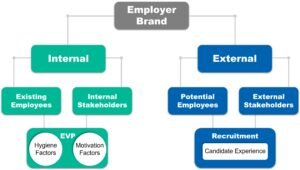
Employer branding is a complicated process that involves organizational attributes, values and culture, such that sometimes it’s hard to distinguish it from other concepts, elements or processes related to or included in it. With that in mind, prior to creating your brand, you need to consider what other elements affect it and how you can leverage your brand strategy through them. A number of these elements are explained below.
Employee Value Proposition (EVP): As the name suggests, EVP is the value that a company promises to deliver to its employees when they work there. It includes monetary and non-monetary benefits your employees expect to receive, such as flexible time, gym membership, the possibility of remote work and career advancement within the company, to name a few. EVP is considered a key component of employer branding.
Employee Satisfaction. Having satisfied employees is one of the basic yet most important conditions of a strong employer brand. Herzberg’s two-factor theory can be a good starting point to evaluate employee satisfaction. In his theory, Herzberg suggests that employees will be satisfied only if they are provided with the hygiene factors – job security, good salary and vacation, for instance. The absence of these factors causes employee dissatisfaction and consequently high turnover.
Employee Engagement: Just as employee satisfaction, employee engagement is positively related to your employer brand. However, you should bear in mind that satisfied employees are not necessarily engaged, while engaged employees are satisfied. According to Herzberg’s theory, motivation factors, including recognition, responsibilities and career advancement, lead to employee engagement at a workplace.
Both employee satisfaction and engagement pertain to internal employer branding.
Recruitment and Candidate Experience: One of the main goals of developing a powerful employer brand is to stand out amongst your competitors in the job market to attract top talent. Recruitment is initially concerned with the external side of an employer brand. This process starts with planning what you need, defining the job description, a persona and it ends with hiring and onboarding the new employee(s). Candidate experience refers to the feelings that candidates experience when they go through the stages of recruiting.
Considering the importance of a good employer reputation in attracting top talent, the key role employer brand plays in this particular process is evident; however, what might be overlooked is the fact that recruitment – as the first point of contact with your potential employees as well as those of other companies – is a major part of the employer branding process.
Benefits of a strong Employer Brand
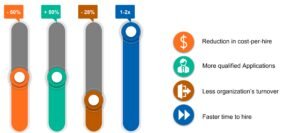
A LinkedIn survey has revealed the following benefits of the employer brand.
Reduction in Cost-per-Hire: Through your delivered EVP, your satisfied and engaged employees are more likely to be the ambassadors of your employer brand among other professionals. As a result, you may need to spend less on your employer brand awareness in the job market.
More Qualified Applicants: It goes without saying that having more qualified applicants means a higher chance of hiring the right and qualified fit for a given position. Studies show that more qualified applicants are more likely to be motivated and engaged at work which, in turn, contribute to higher productivity and better performance level.
Faster Time to Hire & Less Turnover: Although the recruitment process costs companies a considerable amount of money, if done correctly, it greatly benefits business performance. A powerful employer brand not only makes the recruitment process more efficient through pacing up the speed but also reduces the turnover rate, which is even more costly.
Similar to marketing professionals who strive to know their customers and their needs to promote their corporate brand, HR professionals seek to understand employees and their expectations to adopt a strong employer brand. However, this doesn’t mean that that the two brands are not related. On the contrary, they are connected and thus should be aligned. To this end, HR and marketing departments are required to work hand in hand in order to develop reinforcement strategies.
Read more:
- https://linkhumans.com/simon-barrow-creator-employer-brand/
- https://builtin.com/employer-branding/external-employer-branding
- https://blog.honeypot.io/benefits-of-employer-branding/